
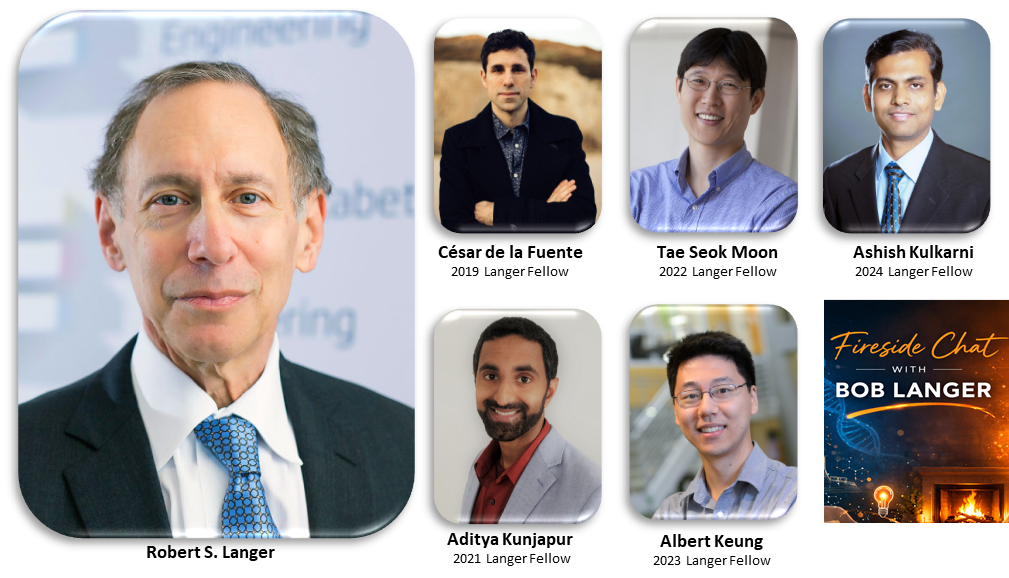
When AIChE Foundation gathered Bob Langer and several Langer Prize recipients for a virtual fireside chat, the discussion offered a rare look at what happens when early-career researchers receive the support to pursue their dreams. The Langer Prize provides an unrestricted award that encourages blue-sky thinking and helps discoveries move toward real-world impact, and the fellows described how quickly that early support can change the trajectory of their work.
The Langer Prize came from the importance of blue-sky ideas and the guts to pursue them. This kind of thing is an intergenerational compact — give back to the endowment so it can be sustained and include more people.” – Eduardo Glandt, Langer Prize Endowment Donor
For 2019 recipient César de la Fuente, the impact began with confidence. “The biggest surprise has been the unexpected nature of the research enabled by the investment and the vote of confidence,” he said. His group combined standardized experimental data with artificial intelligence, and the work soon moved beyond academic research. “We can train high-quality AI models that discover and design new antibiotics to counter infections all the way to the preclinical stage,” he explained. The award made it possible to pursue ideas whose outcomes were uncertain but promising — precisely the type of work early-career researchers often struggles to fund.
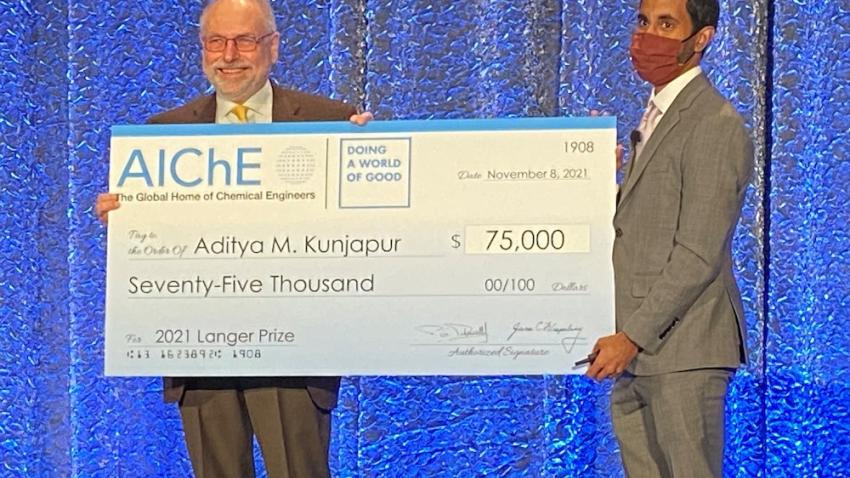
Aditya Kunjapur (2021) described how the recognition accelerated both research and opportunity. “There were surprises in multiple dimensions — follow-on from the Langer Prize funds and the doors that opened,” he said. His startup, Nitro Biosciences, now has lab space and employees, and conversations with industry revealed broader applications. “Our technology could be useful in different ways than we originally thought.” Beyond funding, the visibility of the prize helped establish credibility for work that was still emerging.
For Tae Seok Moon (2022), the recognition marked a turning point. “This award did change my life,” he said, explaining that it reshaped how he approached translation. “Without patents, no technology can be translated.” The prize encouraged him to file patents and launch Moonshot Bio, while also giving him the confidence to pursue ideas he might otherwise have set aside.
Albert Keung (2023) described research at the frontier of biological computing — storing digital data in DNA — and how the award helped his group tackle a central challenge. “We discovered you can create machine-learning models that predict interactions with high accuracy and control off-target interactions,” he said. “That greatly increases the power of what you can do with biology.” He also noted that flexible funding allows researchers to move quickly when opportunity arises, whether hiring talent or advancing a breakthrough.
Ashish Kulkarni (2024) used the award to advance a project aimed at earlier detection of ovarian cancer through blood biomarkers. “We didn’t have a lot of data and no money to pursue this,” he said. After receiving the prize, the team generated confirmatory data, won pitch competitions, and attracted clinicians and investors. “This opened a lot of doors that would not have been possible without the award.” The support allowed a high-risk, early-stage medical idea to move forward rather than stall.
As the discussion turned to advice for young researchers, a consistent theme emerged — meaningful innovation requires environments where risk is allowed. “Without taking risks, you cannot make a big impact,” Moon said. Kunjapur noted, “What’s the worst if they fail? If you design your experiments correctly, you learn and pivot.” De la Fuente also added, “There’s no such thing as failure because you’re continuously learning.”
Langer closed with a story from his own early career, recalling that his first nine grant applications were rejected before he received funding. “One out of ten is still better than zero out of one,” he said.
Listening to the conversation, Eduardo Glandt, a Langer Prize Endowment donor, explained why support for programs like this matter: “The Langer Prize came from the importance of blue-sky ideas and the guts to pursue them. This kind of thing is an intergenerational compact — give back to the endowment so it can be sustained and include more people.”
The Langer Prize gives promising engineers what many breakthroughs require most — early belief, credibility, and the freedom to pursue ambitious ideas before traditional funding systems are ready. For past recipients, it has provided not only resources, but momentum, helping transform promising research into real-world impact.
Applications for the 2026 Langer Prize are now open through March 17. Early-career researchers pursuing bold, innovative ideas are encouraged to apply or nominate a colleague. The next Langer Fellow will be recognized at the AIChE Annual Meeting this November.